TRIGGER WARNING
In the dense, green thickets of Locust Grove, Oklahoma, there stands a tree that once held a terrible truth. Locust Grove was home to Camp Scott, a summer retreat where Girl Scouts from across the region came each year to learn, explore, and sleep under the stars. But on the night of June 12, 1977, the forest became the site of one of the most devastating crimes in Oklahoma history.
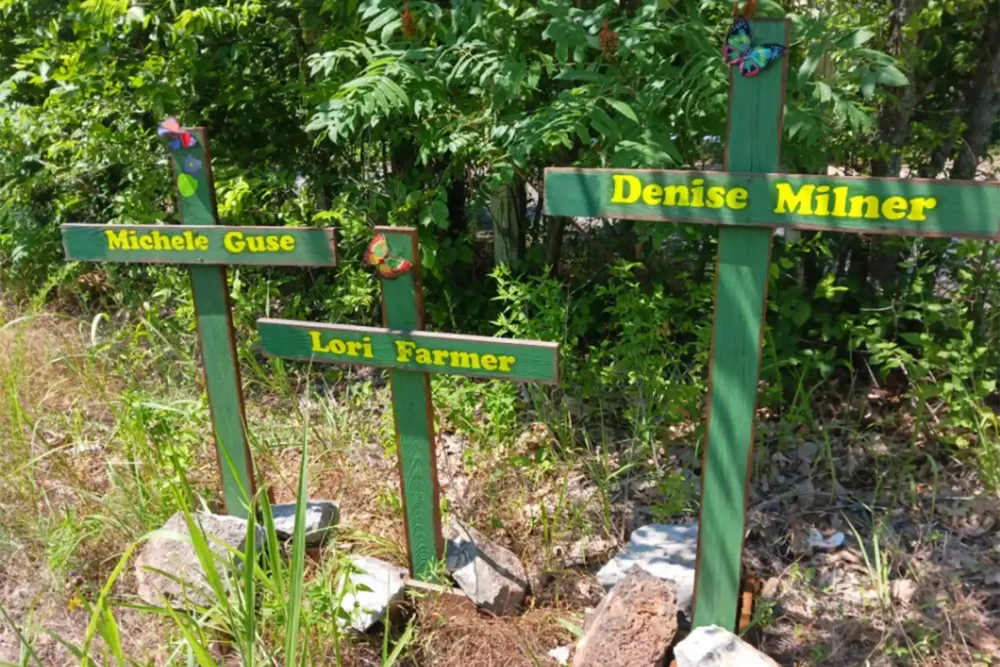
That evening, three young girls—ages eight, nine, and ten—were taken from their tents. All three lost their lives. One of them, Denise Milner, a young Black girl whose life had barely begun, was found against a tree in her final moments. The violence she endured left marks on her family, her community, and on the tree itself.
Investigators later discovered that the bark held physical evidence embedded deep within the wood grain. Officers cut sections of the bark and entered them into the case file. In this way, the tree became more than a silent bystander. It became a witness. It testified when Denise could no longer speak for herself.
Over time, something strange happened. The tree continued to grow—new leaves unfurled each spring, branches stretched upward—but one side of the tree remained dead, the very side where Denise had been. That section hollowed out and darkened, while the rest of the tree thickened and thrived around it. Year after year, the living and the lifeless coexisted in the same trunk, as if the tree itself refused to forget.
No ecological explanation has ever fully accounted for why only that side died. But symbolically, the tree’s growth pattern reads like memory. As if the tree, having witnessed everything, carried the imprint in its body. As if it continued to feel the pain long after the forest fell silent.
The forest around Camp Scott spans more than 400 acres, thick with trees and undergrowth. The witness tree is difficult to find unless you know exactly where to look. Denise’s family did. Every year, they made a pilgrimage back to that tree. They left flowers. They prayed. They honored her life in the only place that still held the imprint of her final moments.
The tree became a marker—not of the crime alone, but of Denise’s presence, her memory, and the way nature sometimes holds onto stories long after humans try to move on. It is the last living being to have seen her alive, and the only one that could testify to what happened.
Today, nearly fifty years later, the witness tree still stands in Locust Grove. It is quiet, unassuming, and tucked deep in the woods. But for those who know its story, it remains one of the most haunting and important memorials in Oklahoma. A tree that carries both grief and growth. A tree that remembers.
And this is why the Locust Grove Tree meets the criteria for a Black Heritage Tree. Although it was not intentionally planted by Black people and was relatively young at the time, it was permanently modified in connection to Black life and Black loss. Its bark, its abnormal growth pattern, and its discoloration became part of the historical record. The tree offered evidence when Denise could no longer speak. It continued to bear witness long after the case was closed.